
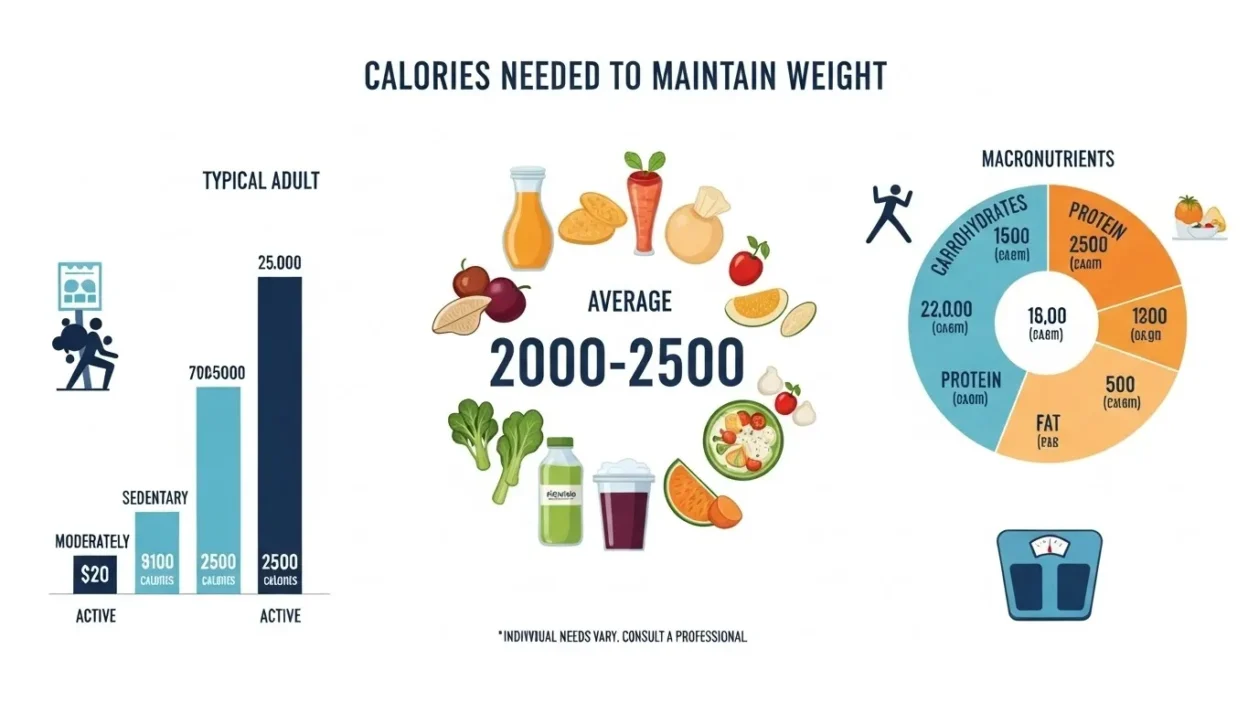
Have you ever wondered, “How many calories do I really need to stay at my current weight?” You’re not alone.
Most people focus on losing or gaining weight, but figuring out your maintenance calories is just as important for staying healthy and consistent.
The tricky part is that there’s no one size fits-all number your daily calorie needs depend on your age, gender, activity level, metabolism, and even muscle mass.
Eating too little can leave you tired, while eating too much can lead to gradual weight gain. The good news?
Once you know how to calculate your calories needed to maintain weight, you can find the sweet spot where your weight stays stable, energy levels stay high, and food feels less stressful.
In this guide, we’ll break it down step by step, give practical examples, and show you how to adjust calories as your lifestyle changes.
What Does Maintaining Weight Really Mean?
When we talk about maintaining weight, it doesn’t mean your body will stay perfectly the same every day. Small fluctuations of a pound or two are normal, and they don’t mean you’re suddenly gaining or losing fat. Essentially, maintaining weight is all about energy balance—the relationship between the calories you eat and the calories your body burns.
Your body uses calories for everything: basic functions like breathing and digesting food (basal metabolic rate), daily activities like walking or working (physical activity), and even the energy used to process your food (thermic effect of food). If the calories you consume roughly match the calories your body burns in a day, your weight will stay relatively stable. That number is what we call your maintenance calories.
It’s important to realize that maintenance calories aren’t a fixed number. They change depending on your activity, age, muscle mass, and metabolism. For example, someone who goes to the gym regularly will have higher maintenance calories than someone who sits at a desk all day.
Finding your personal maintenance calories is key to avoiding unwanted weight changes, staying energized, and enjoying your food without constantly worrying. Later, we’ll show exactly how to calculate it for your unique body and lifestyle so you can take control of your daily calorie needs.
Understanding Calories and Energy Balance
Before we dive into calculations, it’s important to understand what calories actually do. Think of calories as the fuel your body needs to function. Every activity, from breathing to walking to lifting weights, burns calories. If you eat exactly the number of calories your body burns in a day, your weight stays the same—that’s your energy balance.
Calories come from three main macronutrients: protein, carbs, and fats. Protein helps build and repair muscles, carbs give you quick energy, and fats support hormones and overall health. While the type of calories matters for health and satiety, for weight maintenance, the total calories you consume vs. burn is the key factor.
Your daily calorie burn is made up of a few components:
- Basal Metabolic Rate (BMR): Calories your body uses just to stay alive—breathing, circulating blood, and keeping organs running.
- Physical Activity: Any movement, from walking to working out, burns additional calories.
- Thermic Effect of Food (TEF): Digesting and processing food also uses energy, usually around 10% of your intake.
- Non-Exercise Activity Thermogenesis (NEAT): The small movements throughout your day, like fidgeting or taking stairs.
When your calorie intake equals this total burn—your Total Daily Energy Expenditure (TDEE)—your weight remains stable. If you eat more, you gain weight; less, and you lose it. Understanding this balance is the foundation for finding your calories needed to maintain weight, which we’ll calculate in the next sections.
Basal Metabolic Rate (BMR) Explained
Your Basal Metabolic Rate, or BMR, is the number of calories your body needs just to keep you alive. That means everything your body does automatically—breathing, circulating blood, keeping your organs functioning, and even maintaining body temperature—burns calories. Even if you spent the whole day lying in bed, your BMR would still be at work.
BMR is important because it forms the foundation of your daily calorie needs. Think of it as the minimum fuel your body requires before adding in activity and other calorie-burning processes. Most adults burn between 1,200 and 2,000 calories per day just from BMR, but this varies based on several factors:
- Age: Metabolism slows slightly as you get older, reducing your BMR.
- Gender: Men usually have a higher BMR because they typically have more muscle mass.
- Body composition: Muscle burns more calories at rest than fat, so the more lean mass you have, the higher your BMR.
- Genetics: Some people naturally burn calories faster than others.
Knowing your BMR helps you estimate how many calories your body needs before adding activity, which is crucial for calculating your maintenance calories accurately. While BMR isn’t something you can feel or notice daily, it’s the hidden engine powering your metabolism.
Total Daily Energy Expenditure (TDEE)
Once you know your BMR, the next step is figuring out your Total Daily Energy Expenditure, or TDEE. TDEE is the total number of calories your body burns in a day, combining your BMR with all the calories burned through activity, digestion, and even small movements. In other words, this is the number you want to match if your goal is to maintain your weight.
TDEE has several key components:
- Basal Metabolic Rate (BMR): The calories your body burns at rest to keep vital functions running.
- Physical Activity: Any movement counts here—walking, exercising, climbing stairs, or even doing household chores. The more active you are, the higher this number.
- Thermic Effect of Food (TEF): Your body burns calories while digesting, absorbing, and processing food—usually about 10% of your daily intake.
- Non-Exercise Activity Thermogenesis (NEAT): These are small movements that aren’t formal exercise, like fidgeting, standing, or pacing. Surprisingly, NEAT can account for a lot of calorie burn over a day.
Your TDEE will vary depending on your lifestyle. A sedentary office worker may have a TDEE close to their BMR, while a moderately active adult will burn significantly more. Understanding your TDEE is crucial because it tells you how many calories to eat to maintain your weight, not gain or lose.
In the next section, we’ll show how to calculate your TDEE step by step, including the activity multipliers you can use to personalize your maintenance calories.
How Activity Level Changes Maintenance Calories
Not all calories are created equal when it comes to maintaining weight, and your activity level plays a huge role. Even if two people have the same BMR, the one who moves more every day will burn more calories and therefore have higher maintenance calories. This is where activity multipliers come in—they adjust your calorie needs based on how active you are.
Here’s a simple breakdown:
- Sedentary: Little to no exercise. Most of the day is spent sitting. Your maintenance calories are close to your BMR.
- Lightly Active: Light exercise or activity 1–3 days a week. Walking or casual movement increases calories slightly above BMR.
- Moderately Active: Moderate exercise 3–5 days a week, like gym sessions or brisk walking. Calories burned can be 20–40% higher than BMR.
- Very Active: Hard exercise 6–7 days a week or a physically demanding job. TDEE can be 50% or more above BMR.
Even small changes in daily activity, like taking the stairs or walking during breaks, can increase your calorie burn over time. This is why two people with the same weight and height might have very different maintenance calories—activity is a major factor.
Knowing your activity level is key because it helps you calculate your TDEE accurately. Once you know that, you can finally figure out your calories needed to maintain weight without guessing or stressing over numbers.
How to Calculate Calories Needed to Maintain Weight – Step by Step
Now that you understand BMR, TDEE, and activity levels, it’s time to figure out your maintenance calories. Don’t worry—it’s easier than it sounds. Here’s a simple step-by-step process:
Step 1: Calculate Your BMR
Your BMR is the calories your body burns at rest. You can calculate it using formulas like Mifflin-St Jeor, or an online BMR calculator. For example:
- Men: BMR = 10 × weight (kg) + 6.25 × height (cm) − 5 × age (years) + 5
- Women: BMR = 10 × weight (kg) + 6.25 × height (cm) − 5 × age (years) − 161
This gives you a baseline number of calories your body needs to survive.
Step 2: Apply an Activity Multiplier
Next, adjust for your daily activity level:
- Sedentary (little or no exercise) → BMR × 1.2
- Lightly active (light exercise 1–3 days/week) → BMR × 1.375
- Moderately active (moderate exercise 3–5 days/week) → BMR × 1.55
- Very active (hard exercise 6–7 days/week) → BMR × 1.725
- Extra active (very hard exercise or physical job) → BMR × 1.9
This gives your TDEE, the total calories your body burns daily.
Step 3: Adjust and Monitor
Your TDEE is an estimate, so track your weight for 1–2 weeks. If your weight is stable, you’ve found your maintenance calories. If it’s going up or down, adjust by 100–200 calories until you find the sweet spot.
Following these steps ensures you eat enough to stay energized while keeping your weight steady. Knowing your calories needed to maintain weight takes the guesswork out of eating and helps you enjoy food without stress.
Example Maintenance Calorie Calculations
Sometimes seeing actual numbers makes it much easier to understand how maintenance calories work. Let’s go through a few examples for different activity levels:
Example 1 – Sedentary Adult
- 30-year-old woman
- 65 kg (143 lbs), 165 cm (5’5”)
- Little exercise (desk job)
BMR calculation: 10 × 65 + 6.25 × 165 − 5 × 30 − 161 = 1,377 calories
TDEE: 1,377 × 1.2 (sedentary) ≈ 1,652 calories/day
Example 2 – Moderately Active Adult
- 28-year-old man
- 75 kg (165 lbs), 180 cm (5’11”)
- Exercises 4 times a week
BMR calculation: 10 × 75 + 6.25 × 180 − 5 × 28 + 5 = 1,768 calories
TDEE: 1,768 × 1.55 (moderately active) ≈ 2,738 calories/day
Example 3 – Highly Active Individual
- 35-year-old woman
- 60 kg (132 lbs), 170 cm (5’7”)
- Intense training 6–7 days/week
BMR calculation: 10 × 60 + 6.25 × 170 − 5 × 35 − 161 = 1,365 calories
TDEE: 1,365 × 1.725 (very active) ≈ 2,353 calories/day
These examples show that activity level makes a huge difference. Two people with similar weight and height can have very different maintenance calories depending on their daily movement.
The key takeaway: knowing your BMR and activity level helps you personalize your daily calorie intake so you can maintain weight without constant guesswork or stress.
Calories Needed to Maintain Weight by Gender and Age
Your calories needed to maintain weight aren’t the same for everyone. Gender and age play a major role in determining how many calories your body burns each day.
Gender Differences
Men generally have higher maintenance calories than women. This is mainly because men usually have more muscle mass, which burns more calories at rest. For example, a moderately active man might need 2,500–2,800 calories per day, while a woman with the same activity level and weight might need 2,000–2,300 calories per day.
Age Differences
Age also affects your calorie needs. Younger adults tend to have faster metabolisms and higher BMRs. As we age, BMR naturally slows down, meaning our bodies burn fewer calories at rest. A 25-year-old might maintain weight on 2,400 calories/day, while a 50-year-old with the same weight and activity level might only need around 2,200 calories/day.
Why This Matters
Understanding these differences helps you set realistic calorie goals. If you’re not accounting for gender or age, you might over- or under-estimate your maintenance calories, which can lead to unwanted weight changes.
The good news is that once you know your BMR, TDEE, and activity level, you can adjust for age and gender to find your personalized maintenance calories. Tracking your weight over a couple of weeks will confirm if your estimate is accurate.
Role of Muscle Mass and Body Composition
When it comes to calories needed to maintain weight, not all bodies are equal. One of the biggest factors is muscle mass. Muscle burns more calories at rest than fat does, which means someone with more lean mass will have a higher BMR and, therefore, higher maintenance calories.
Think of it like this: muscle is like a small engine that’s always running, even when you’re sitting or sleeping. Fat, on the other hand, is more like storage—it doesn’t burn as much fuel. This is why two people of the same weight can have very different maintenance calories depending on their body composition.
How This Works in Practice
- A muscular person weighing 70 kg may need 2,600–2,800 calories/day to maintain weight.
- Someone with the same weight but lower muscle mass may only need 2,200–2,400 calories/day.
Why It Matters
This is also why strength training is a great tool for weight maintenance. Building lean muscle slightly raises your maintenance calories, making it easier to stay at your desired weight without strict dieting.
Key Takeaway
Maintenance calories aren’t just about the scale—they’re about what your body is made of. By understanding your body composition, you can fine-tune your calorie intake to match your unique metabolism and maintain your weight more effectively.
Signs You’re Eating at Maintenance
Knowing your calories needed to maintain weight is one thing—but how do you actually know if you’re hitting that sweet spot? Luckily, your body gives several clear signs when you’re eating at maintenance calories.
1. Stable Weight
The most obvious indicator is that your weight stays relatively stable over a few weeks. Small daily fluctuations are normal due to water and food intake, but your overall weight shouldn’t trend up or down.
2. Consistent Energy Levels
If you feel alert, focused, and energetic throughout the day, it’s a good sign that your calorie intake matches your body’s needs. Low energy, frequent fatigue, or mid-day crashes can mean you’re eating too little.
3. Balanced Hunger
Eating at maintenance doesn’t leave you constantly hungry or overly full. Your hunger cues should feel normal, and you should feel satisfied after meals without needing constant snacking.
4. Exercise Performance
If your workouts feel strong and you recover well, your calories are likely supporting your activity. Struggling to lift your usual weights or running out of energy quickly may indicate you need more calories.
5. Healthy Mood and Sleep
Calorie balance affects hormones, mood, and sleep. Feeling stable emotionally and sleeping well is another subtle signal that you’re eating the right amount.
By paying attention to these signs, you can fine-tune your calorie intake without obsessing over numbers. Tracking for a week or two, then adjusting slightly if needed, is the most practical way to find your personal maintenance calories.
How to Adjust Maintenance Calories Over Time
Finding your calories needed to maintain weight isn’t a one-time calculation. Your body changes over time, and so do your calorie needs. Knowing how to adjust ensures your weight stays stable even as your lifestyle, age, or activity level shifts.
1. Monitor Your Weight
Track your weight for 1–2 weeks. If it starts creeping up or down by more than 0.5–1 kg (1–2 lbs), it’s time to adjust your calorie intake.
2. Account for Lifestyle Changes
If you start exercising more, your TDEE increases, meaning you’ll need more calories to maintain weight. Conversely, if you become more sedentary, your calorie needs decrease.
3. Consider Aging
As you age, your metabolism naturally slows, and you may lose muscle mass. This means your maintenance calories decrease, even if your weight stays the same. Adjust slowly, typically by 100–200 calories per day, depending on changes.
4. Track Body Composition
Sometimes weight stays the same but body composition changes. If you’re building muscle or losing fat, you may need to tweak calories to match your new metabolism.
5. Make Small Adjustments
The key is gradual changes. Large swings in calories can lead to unwanted weight gain or loss. Adjust 100–200 calories at a time, then monitor results over 1–2 weeks.
By paying attention to your body, activity, and lifestyle changes, you can maintain weight efficiently without obsessing over every meal. Learning to adjust as life changes is what keeps your weight stable in the long run.
Common Mistakes When Calculating Maintenance Calories
Even when you know the formulas and steps, people often make mistakes that lead to inaccurate maintenance calorie estimates. Avoiding these pitfalls can save you from frustration and unwanted weight changes.
1. Overestimating Activity Levels
Many people assume they’re more active than they really are. Walking a few minutes between meetings doesn’t count as heavy exercise. Overestimating activity can inflate your TDEE, leading to gradual weight gain.
2. Ignoring Liquid Calories
Beverages like coffee drinks, sodas, and smoothies add calories quickly. People often forget these, which can tip the energy balance toward weight gain. Always consider all sources of calories, not just meals.
3. Relying Solely on Formulas
BMR and TDEE calculators give estimates, not exact numbers. Your true maintenance calories depend on individual metabolism, muscle mass, and daily movement. Always track your weight for 1–2 weeks to fine-tune your intake.
4. Making Large Adjustments Too Quickly
Changing your calories drastically can lead to unnecessary weight fluctuations. Gradual changes of 100–200 calories at a time are more effective for staying at maintenance.
5. Ignoring NEAT (Non-Exercise Activity)
The small movements throughout your day—fidgeting, walking to meetings, household chores—can significantly impact calorie burn. Ignoring NEAT can underestimate your TDEE and maintenance calories.
By being aware of these common mistakes, you can calculate your calories needed to maintain weight more accurately and avoid frustration. Remember, the goal is consistency, not perfection, and small tweaks over time make a big difference.
Calories vs Food Quality – What Matters More?
When it comes to maintaining weight, many people wonder: Is it just about calories, or does food quality matter too? The short answer is both. While calories determine weight stability, the type of food you eat affects your energy, satiety, and overall health.
For example, 2,000 calories from whole, nutrient-dense foods—like lean protein, vegetables, whole grains, and healthy fats—will keep you fuller and more energized than 2,000 calories of candy, chips, or sugary drinks. Protein is particularly important because it supports muscle maintenance, which in turn raises your BMR and keeps your metabolism more efficient.
Carbs provide energy for workouts and daily activities, while fats support hormones and brain function. Ignoring food quality may not immediately affect your weight, but over time, it can impact muscle mass, energy levels, and overall health.
Practical Tip
Focus on hitting your maintenance calories first, then prioritize nutrient-dense foods. This combination ensures you stay at your desired weight, feel energetic, and support long-term health.
Remember: staying at maintenance isn’t a free pass to eat anything—it’s about balancing total calories with quality choices. When done right, you can maintain your weight, enjoy your meals, and feel good every day without stress or restriction.
Maintaining Weight Without Counting Calories
Not everyone wants to track every calorie, and the good news is you can maintain weight without obsessing over numbers. The key is to focus on portion control, habits, and listening to your body.
1. Use Hunger Cues
Eat when you’re hungry and stop when you’re satisfied—not stuffed. Paying attention to natural hunger and fullness signals helps you stay close to your maintenance calories without tracking.
2. Focus on Balanced Meals
Include protein, complex carbs, healthy fats, and fiber at each meal. Balanced meals keep you full longer, support muscle maintenance, and prevent overeating.
3. Stay Active Daily
Even small movements matter. Walking, taking stairs, or doing household chores adds up and helps you burn extra calories without structured exercise.
4. Monitor Trends, Not Daily Fluctuations
Your weight naturally fluctuates day-to-day. Focus on trends over 1–2 weeks instead of obsessing about every meal. This approach helps you spot when adjustments are needed.
5. Adjust Intuitively
If your weight starts creeping up, reduce portion sizes slightly or move a bit more. If your energy drops or weight dips, eat slightly more. Small, mindful adjustments work better than strict calorie counting.
The bottom line is that calorie awareness and habits can replace constant tracking. By eating mindfully, staying active, and monitoring trends, you can maintain your weight, feel energetic, and enjoy your meals without stress.
Frequently Asked Questions (FAQs)
1. How accurate are calorie calculators?
Calorie calculators give a good starting point, but they are estimates, not exact numbers. Your true maintenance calories can vary based on metabolism, muscle mass, and daily activity. Tracking your weight for 1–2 weeks helps fine-tune your intake.
2. Can maintenance calories change daily?
Yes! Your calorie needs fluctuate slightly based on activity, sleep, stress, and even the food you eat. However, long-term trends are more important than daily variations.
3. Is 2,000 calories enough to maintain weight?
Not necessarily. While 2,000 calories is often used as a reference, maintenance calories are highly individual. Depending on weight, height, gender, age, and activity, many people need more or less than 2,000 calories to maintain their weight.
4. Can I maintain weight while eating junk food?
Technically, yes—if your total calories match your TDEE. However, poor-quality foods may leave you hungry, low on energy, and impact health. For sustainable maintenance, focus on nutrient-dense foods.
5. How long should I track calories?
Track for at least 1–2 weeks to see trends. This gives you enough data to know if your current intake matches your maintenance calories, then you can adjust as needed.

I’m the Joke Master behind JokeDrops.com. I live to make people laugh with clever puns, funny lines, and daily humor drops. Spreading smiles is my favorite job — one joke at a time!